 I know we are to say thank you to at least two classmates (and I will), however, I also wanted to thank everyone. I have learned from all your comments, posts, and blogs. You have taught me, helped me look at myself. and stretched me to look even further outside of the box than I already do. I wish you all the best of luck in your life's journey in developing, teaching, and loving our future society-our children.
Friday, December 16, 2016
I Just Wanted to Say Thank You!
I know we are to say thank you to at least two classmates (and I will), however, I also wanted to thank everyone. I have learned from all your comments, posts, and blogs. You have taught me, helped me look at myself. and stretched me to look even further outside of the box than I already do. I wish you all the best of luck in your life's journey in developing, teaching, and loving our future society-our children.

It's All in the Relationships!
 The information I gained on brain development and the effects of stress on that development is what is driving me to learn all I can about ways I can make a difference.
 I have always dreamed of saving those children no one really sees. Now I feel I am equipped to do just that!
Saturday, December 3, 2016
Final Thought on Testing
Curious kids learn how to learn and how to enjoy it-and that, more than any specific body of knowledge, is what they will need to have in the future.
Amanda Lang (Wright, 2013)
Children need to play to learn and in my humble opinion it only makes sense to "play" to be tested or assessed. Sal Khan (2016) made a very good point in his Ted Talks presentation stating that even if a student receives a 95% on a test there is still 5% that same student does not know in that one particular subject. Instead of teachers going back to reteach the 5% the student did not know we move onto the next subject. This may continue on and on always leaving 5% which adds up until the child hits a wall in a more advanced subject. The student then believes she/he was not meant to learn. What is suggested by Mr. Khan is to teach mastery education which is learning all there is to know and to make sure that each child knows 100% of the subject. Children love video games so there are now computer games that assess while the children play. When children do not know there are tests going on they are less stressed. We need to teach our children how to learn not how to memorize.
Khan,S. (2016) Let's teach for mastery-not test scores. Retrieved from https://www.ted.com/talks/sal_khan_lets_teach_for_mastery_not_test_scores.
Wright, S. (2013). Academic teaching doesn't prepare students for life. Retrieved from plpnetwork.com/2013/11/07/obsession-academic-teaching-preparing-kids-life/
Standardized Testing in China
I chose to look at testing in China for two reasons. The first is becasue I hear the U.S. is often compared to China and Japan in our educational strengths or lack of it. My main reason for looking at this country is because I am seeing more Chinese in my classroom and I had an interesting parent teacher conference with the father of one of my Asian students. Keep in mind my Head Start students are three years old and some are non-English speaking. I feel this little guy I am going to speak of is doing an amazing job with all his learning feats. As I spoke to the father about the various skills we look at in our program there were a couple of areas this little one "graded" lower due to the language barrier. What surprised me was when we spoke of a lower area the father would apologize for his son not doing better. I kept explaining this was completely normal for an English Language Learner and a three year-old. This whole long story to say, Chinese students face a highly competitive and stressful examination system (Rotberg, 2006). In China it is all about the test because that is what gets you into college. The main problem is the rich are the ones who do well as they can afford to prepare the students for the test. The very rich families send their children abroad to learn to avoid testing all together (Lensen, 2011). High school curriculum is entirely based on preparing for the tests completely dominating all other material (Lensen,2011).
Lensen,B. (2011). Standardized testing in China: what it says about American college prep. Retrieved from http://www.straighterline.com/blog/standardized-testing-in-china-what-it-says-about-american-college-prep/
Iris C. Rotberg(2006) Assessment Around the World November 2006 | Volume 64 | Number 3 NCLB: Taking Stock, Looking Forward Pages 58-63 http://nespap.unescobkk.org/wp-content/uploads/2015/12/Assessment-Around-the-World.pdf
Lensen,B. (2011). Standardized testing in China: what it says about American college prep. Retrieved from http://www.straighterline.com/blog/standardized-testing-in-china-what-it-says-about-american-college-prep/
Iris C. Rotberg(2006) Assessment Around the World November 2006 | Volume 64 | Number 3 NCLB: Taking Stock, Looking Forward Pages 58-63 http://nespap.unescobkk.org/wp-content/uploads/2015/12/Assessment-Around-the-World.pdf
Uggg! Standardized Tests!
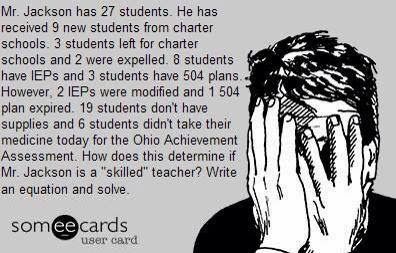
This is a silly way to begin but often more true than not. As a "testaphobe" I feel we have got to come up with another way of assessing children's knowledge. Children must be assessed to gain insight to their knowledge but it must be the whole child not just the academic child. Research shows that some of the least engaged students are the highest achievers (Wright, 2013). The reason for this is becasue these students have learned how to "do school" yet are only retaining information for the test and then it is out of their heads. Passing these tests says a child is good at school but does not say this same child will grow to show empathy for other human beings, be able to manage money, or give back to the community. Schools need to do assessments in ways that the child does not necessarily know she/he is being tested. There are so many technology tools that can be used in-which the child feels she/he is playing a game. Teachers can use group project and portfolios as well as any tests that may be needed. To assess children in this fashion teaches the child how to learn which she/he will continue on into adulthood. We need to think of the child in our classroom not only as a kid we have for ten months but how we can educate who that child could grow up to be.
Wright, S. (2013) Academic teaching doesn't prepare students for life. Retrieved from plpnetwork.com/2013/11/07/obsession-academic-teaching-preparing-kids-life/.
Saturday, November 19, 2016
Post Traumatic Stress Syndrome
As a survivor of Post Traumatic Stress Syndrome I have a special passion for those children who suffer as well. There is emerging evidence that the "toxic stress" , such as poverty, maltreatment, abuse, etc., interacts with genetic vulnerabilities to cause permanent structural and functional changes to the brain (Klein, Gorter & Rosenbaum. 2013. pg. 765). Those children who exhibit developmental problems such as ASD or FASD often receive support services. Children who develop issues due to stress factors, such as SDHD or ODD often do not receive support and carry damaging stigma. No real studies can be done in this area becasue the experiments would have to be conducted allowing abusive parents to continue to do so. Children who suffer these various stress factors often develop PTSD which goes diagnosed due to behavioral issues. The issues which may present themselves are learning disabilities, behavioral concerns, attachment issues, with-drawn, shyness, and so-on. When a child acts out in the classroom we must look closely at what else may be going on.
Resource:
Klein, B., Gorter, J. & Rosenbaum, P. (2013). Diagnostic shortfalls in early childhood chronic stress: a review of the issues. Child: Care, health & Development. 39(6)765-771.
I would like to begin this personal story with complete respect for my parents who did the best they knew how. I was not a planned baby to two young parents but was welcomed and loved. However, the stress level for me growing up was pretty intense. One parent was depressed and the other was a walking anger time bomb that I was never sure when it would go off or for what reason. There were five children with me as the oldest so I took most of the brunt of the anger becasue I felt I needed to protect my siblings. I was intensely shy and terrified of most adults. I hated school and felt the safest being outside or in some imaginary world. My mother told me I had an IQ test, as was customary for the day, and I was way above average. I never felt "smart" and barely made it through each year with a passing grade, I struggle with this self-concept still today. Children often grow up with the self image they are taught as young children and I am no exception. I feel extremely disrespectful discussing my parents in this way becasue they grew and matured and, as I said before, did the best they knew how. I feel my young childhood was influenced by the stress in my household and it affected many aspects of my life, but I am strong and resilient and I worked hard to instill this into my own children and each of my students.
Subscribe to:
Posts (Atom)